Closing the Loop: How LōD Unifies Node-Level Power Control with Spatiotemporal Workload Routing
Software-only inference routers can't see the power grid. Facility-only energy tools can't see API workloads. LōD closes that gap by unifying node-level power telemetry with real-time, spatiotemporal workload routing.
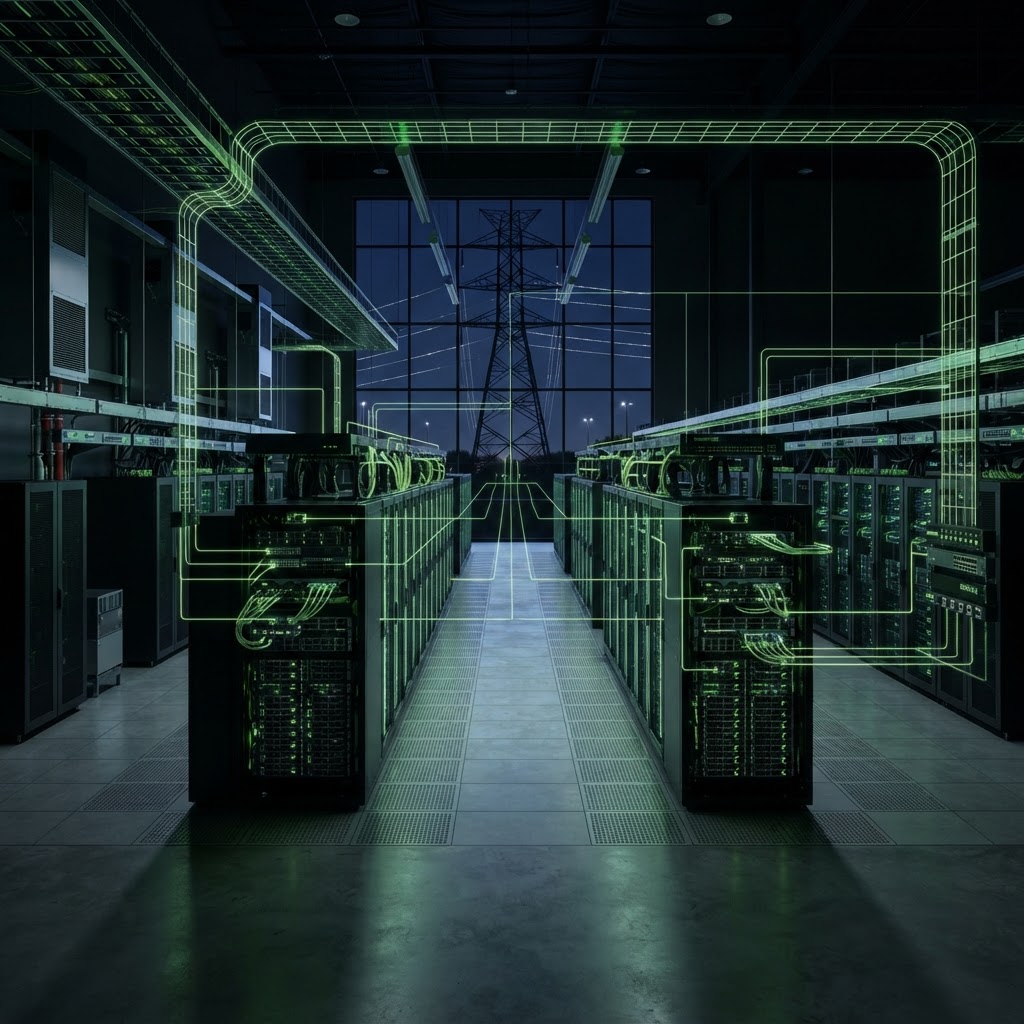
AI infrastructure has a disconnect at its core. Inference routers built purely in software optimize for latency and availability, but they have no visibility into the power grid underneath them. Facility-level energy tools do the opposite: they manage curtailment, batteries, and cooling at a single site, but they have no idea what workload is actually running or where else it could go. Each side is optimizing half the problem.
That gap is becoming expensive. AI racks now draw 40 to 100+ kW, while the legacy grids feeding them are hitting peak capacity in the same regions where compute demand is growing fastest. Real compute efficiency requires connecting hardware-level power telemetry with workload routing, not treating them as two separate systems that happen to share a building.
Bottom-Up — Hardware & Node-Level Energy Intelligence
The first layer is the Data and Execution Layers: LōD IoT and LōD Energy. This is where the platform watches the physical reality of a site in real time.
Sub-30-second node-level telemetry feeds automated curtailment logic that can throttle or shed load the moment a grid signal demands it, without waiting on a human to interpret a dashboard. That speed matters because grid transients don't wait for quarterly reviews or even five-minute market intervals.
At the same time, the platform co-optimizes battery energy storage (BESS), GPU power states, and liquid cooling as a single system rather than three independent controls. When a local grid event hits, the site needs its batteries, its compute power draw, and its cooling capacity to move together, not in whatever order each vendor's firmware happens to react.
Top-Down — Spatiotemporal Workload Routing
The second layer is the Workload Layer: LōD Flexible Compute and the CLōD platform. This is where the platform looks across sites instead of down into one.
Spatiotemporal routing means moving inference and training jobs across a fiber network based on live energy prices and grid conditions, in real time, not on a static schedule. Instead of a workload running wherever it was originally deployed, it runs wherever power is currently cheapest and most stable, without the application layer ever noticing the difference.
This is geographic arbitrage applied to compute: routing AI inference requests to regions with cheap, abundant power. Done well, this kind of routing slashes compute costs by 30 to 60 percent, simply by matching workload placement to grid economics instead of fixed infrastructure.
Closing the Loop — Why Two Layers Are Better Than One
On their own, each layer solves half the problem. Node-level curtailment protects a single site during a grid event, but it can mean turning away or delaying work that other sites could easily absorb. Workload routing moves jobs to cheaper regions, but without hardware-level telemetry, it has no early warning that a specific site is about to become power-constrained.
Combining hardware curtailment with software routing creates a closed-loop system: the node layer sees the problem first, and the workload layer solves it immediately.
Consider a local grid spike at one site. LōD automatically throttles the affected nodes based on live telemetry, while LōD Flexible Compute reroutes incoming workloads to an underutilized site in a different region, in the same motion. SLAs stay intact because the workload never actually stops, it just moves. Profit margins stay intact because the site captures demand-response value instead of eating a scarcity-price bill. Neither outcome is possible with only one half of the system.
Executing this in under 30 seconds is what makes the difference between a closed loop and a missed opportunity. Grid conditions and spot prices change faster than manual coordination can follow. Machine-speed automated response is what lets an operator protect enterprise SLAs while still capturing the revenue available from grid demand-response programs.
Grid Flexibility as a Growth Catalyst
There's a second-order benefit beyond cost and reliability. Grid-aware data centers that can genuinely flex their load are the ones best positioned to bypass utility interconnection queue delays. Utilities are far more willing to unlock incremental capacity for a customer who can demonstrably shed or shift load on demand than for one that can only ever pull at a fixed rate. Flexibility becomes a credential that speeds up how fast a site can get to power in the first place.
Conclusion: Power as a Competitive Advantage
Power is quickly becoming the real constraint on AI growth, ahead of chip supply. Operators who treat power as a fixed operational cost will keep losing margin to it. Operators who close the loop between hardware telemetry and workload routing turn that same constraint into a lever: lower compute costs, protected SLAs, and faster access to capacity.
That is the thesis behind LōD's platform, and it is what a genuinely unified energy and compute strategy looks like in practice.
Ready to see what closing the loop could mean for your operation? Book a LōD Energy Strategy Call and we'll walk through your current exposure across both layers.